
Is the Next Subprime Hiding in a Data Centre?
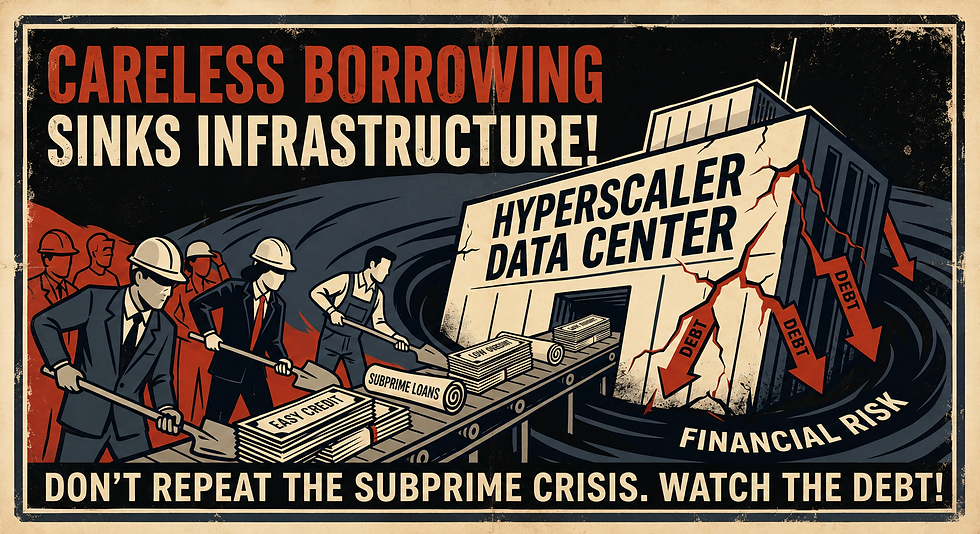
Banks are learning to distribute AI’s debt before the cycle has been tested. That should make investors nervous.
Every speculative era begins with an invention and ends with a balance sheet. The invention gets the applause. The balance sheet eventually sends the bill.
For artificial intelligence, that bill is arriving in concrete, copper and debt. What began as a story about models and software has become a race to secure land, power, cooling, chips, fibre and financing. The Financial Times’ recent report that global banks are exploring private deals and significant risk transfers to reduce exposure to data-centre debt should be read in that light. This is not just another story about AI demand. It is a story about where the risk is moving. When banks that originated the exposure start trying to place it elsewhere, the cycle has entered a different phase.
No one should pretend that a data centre is a subprime mortgage. It is not. A data centre has walls, tenants, servers and power contracts. It may have blue-chip customers and long-term leases. AI, unlike many of the more absurd bubbles of the past, is not imaginary. Yet that is precisely why the danger is easy to miss. In 2008 the great lesson was not that houses were worthless. Houses were real. The lesson was that real assets can be financed in unreal ways.
Subprime became fatal when credit ceased to be held by those who had made it, and began moving through an assembly line. Mortgages were originated, packaged, tranched, rated and sold until the link between borrower and ultimate risk-holder became almost decorative. Ben Bernanke later observed that end-investors often relied mainly on ratings, while the information needed for independent credit analysis was often difficult or impossible to obtain.
The important phrase was not “housing”. It was “originate to distribute”.
The AI boom has its own version of that machinery. It is more respectable, more institutional and better regulated. It also has better branding. The mortgage pool has become the AI infrastructure sleeve. The CDO has become asset-based finance. The retail brokerage pitch has become access to private credit. The comforting AAA badge has been replaced by other comforting words: contracted cash flows, secured exposure, hyperscaler tenancy, infrastructure income.
The first myth to retire is that the cloud is light. It is not. It is an industrial estate with an electricity habit. The International Energy Agency says data centres house servers, storage, networking equipment, cooling systems, backup power and grid connections. Its base case has global data-centre electricity consumption doubling to around 945 terawatt-hours by 2030. Just as important, the IEA notes that a data centre can be operational in two or three years, while the energy system around it often requires much longer lead times and high upfront investment.
That mismatch between technology speed and infrastructure speed is where much of the risk lives.
It is also why so much debt is needed. Data centres require vast upfront expenditure before revenues fully arrive. Land must be acquired, sites permitted, power secured, buildings erected, cooling installed and servers deployed. A long-term lease can make the cash flows look bond-like, but the route to those cash flows is messy, physical and capital-intensive.
The Financial Stability Board (FSB) says private credit is now playing a critical role in financing AI-related data-centre investment because internal cash flows from technology companies are proving insufficient for the capital required. It cites estimates of $2.9tn of AI infrastructure capex between 2025 and 2028, with $1.5tn expected to come from external capital, including $800bn from private credit.
This is the boom’s financial anatomy. A developer secures a site and a tenant, or at least a credible path to one. The tenant’s name turns an expensive building into a financing story. Banks arrange construction debt. Private credit funds, insurers and asset-backed lenders join the queue. The project is no longer merely a facility. It is collateral. It is paper. It is spread. It is product.
None of this is inherently wrong. Debt built the modern world. Railways, power stations, ports, fibre networks and airports were all financed before they were fully used. But the most dangerous credit cycles usually start with a good asset and a plausible thesis. Bad assets are obvious. Good assets financed too aggressively are more treacherous.
Banks seek to offload risk to avoid ‘choking’ on data centre debt
That is why the FT headline matters. Banks are not running away from AI. They still want the fees, the relationships and the prestige of financing the most important technology build-out in a generation. What they do not want, at least not without limit, is the whole exposure trapped on their own balance sheets.
Significant Risk Transfers (SRT or Sell Risk to Retail) help solve that problem. The Basel Committee says these transactions allow banks to transfer all or part of the credit risk of a pool of assets to another counterparty while retaining ownership of the underlying assets; it also says private investment funds dominate the investor base for such structures.
That distinction is important. The bank may still look like the lender. The borrower relationship may remain intact. The transaction may still carry the aura of institutional sponsorship. But the economic exposure has begun to migrate. In finance, migration is often sanitised as risk management. Sometimes it is. Sometimes it is the polite word for passing the parcel.
Reuters recently reported that Meta is working with Morgan Stanley and JPMorgan on a financing package of roughly $13bn for an El Paso data centre, with Bloomberg first reporting that most of the financing is expected to be debt. Meta’s project, due to open in 2028, is not evidence of weakness; it is evidence of scale. Big Tech, long reluctant to raise debt, is now more willing to borrow to win the AI infrastructure race.
The question is not whether Meta can finance a data centre. It can. The question is what happens when the same logic is repeated across an industry, then repackaged for investors who are chasing yield under the banner of AI.
The official warnings are already visible. The FSB notes that AI-related private credit has grown sharply, with the sector’s share of private credit deals reaching 34% in 2025, up from an average of 17% over the previous five years. It also warns that a correction in asset valuations, electricity shortfalls, project delays or data-centre overcapacity could produce sizeable credit losses for private-credit investors.
The vulnerability is not that AI demand will vanish. It does not need to. Many credit blow-ups occur not because the theme was false, but because the theme was over-levered. The internet was real; telecom debt still collapsed. Railways were real; railway investors still lost fortunes. Housing was real; mortgage securities still nearly broke the global financial system.
A data-centre loan can fail in prosaic ways. Power may arrive late. The grid may be constrained. Construction may run over budget. A tenant may defer capacity. A refinancing may coincide with a closed credit market. An asset designed for one generation of chips may be less valuable for the next. A region may have too many projects chasing the same power, labour and customers.
None of these outcomes requires an AI winter. They require only a boom to have been underwritten as though bottlenecks, cycles and disappointment had been abolished.
The Bank for International Settlements has raised a more subtle alarm. Outstanding private-credit loans to AI-related companies have risen from near zero to more than $200bn and could reach $300bn-$600bn by 2030. Yet the terms of private-credit loans to AI-related companies do not differ markedly from those in other sectors, despite their larger size and the elevated expectations surrounding the industry. The BIS conclusion is bracing: either lenders are underestimating AI investment risk as their exposures grow, or equity markets are overestimating the cash flows AI will produce. It adds the line that should be printed on every AI credit memorandum: leverage does not disappear by being out of sight.
The next layer of discomfort is who ends up holding the paper. Private credit once sounded like a club for institutions. Increasingly, it is becoming a product for wealth channels. The FSB says retail investors in the United States have become a growing part of private credit through Business Development Companies (BDCs) and registered investment companies, with their share of assets under management rising from virtually zero to about 13% over the past decade. It also warns that retail investors may not fully understand the illiquidity of the asset class, a problem that can amplify redemption requests during stress.
This is where the 2008 analogy stops being rhetorical and becomes moral.
The borrower is not the same. The asset is not the same. The legal structures are not the same. But the social pattern is recognisable. Sophisticated institutions manufacture exposure to a fashionable asset class. The exposure becomes too large or too concentrated to sit comfortably in one place. It is renamed, divided and distributed. By the time it reaches the end buyer, the danger has been buried under a more attractive label.
In the last cycle, the label was home ownership. Then it was diversification. Then it was AAA.
In this cycle, the label is AI infrastructure. Then private credit. Then stable income.
The private client is not told they are buying exposure to a complex chain of construction risk, grid risk, tenant risk, refinancing risk, technological risk and valuation risk. They are told they are gaining access to the most important investment theme of the age. The word “access” is doing the work that “rating” once did. It converts caution into fear of missing out.
This does not mean every AI data-centre loan is toxic. Some will be excellent credits. Some sponsors will make fortunes. Some assets will become indispensable infrastructure. The point is not to deny the future; it is to separate the future from the financing of it. A technology can be transformative and still leave creditors nursing losses. Indeed, transformative technologies often do exactly that, because they attract too much capital too quickly.
By 2028, the story should be clearer. Projects launched in the present frenzy will have to move from promise to performance. They will need power, tenants, utilisation and refinancing. The same year will mark the 20th anniversary of the crash that supposedly taught markets to distrust complexity, leverage and the comforting assumption that risk had been dispersed safely.
Perhaps the lesson has been learned. Banks are better capitalised than they were. Securitisation is more scrutinised. Risk-transfer markets are watched more closely. Data centres are not no-doc mortgages. All true.
Yet the most persistent vice in finance is not ignorance. It is memory loss at the top of a cycle.
The next subprime, if it comes, will not arrive looking like the old one. It will not be a mortgage pool filled with weak borrowers and teaser rates. It will come wearing the language of infrastructure, energy transition, AI productivity and private-market access. It will have a data room, a blue-chip tenant, a long lease, a glossy deck and a respectable arranger.
It will hum rather than shout. That is what makes it dangerous.
The lesson of 2008 was not to avoid mortgages. It was to be suspicious when an industry learns how to turn a hot story into yield, yield into product, and product into someone else’s problem. AI may change the world. The debt raised to build it may still be mispriced. Both things can be true at once.
When banks begin to move risk off their books, investors should not assume a conspiracy. They should assume the banks have remembered something markets forget too easily: the future may be exciting, but the first loss is real.
The servers are humming. So was the mortgage machine.
Louay Aldoory is a Co-founder at 1648 Capital. 1648 Capital is a corporate advisory and private markets platform partnering with founders, shareholders, and investors on complex growth, restructuring, and capital structuring initiatives. We combine strategic insight with execution discipline, supporting businesses from transformation through to institutional capital alignment.
The strategies presented are thematic and do not constitute investment advice (or advice of any kind). No assurance can be given that the objectives of the investment above strategies will be achieved; the strategies involve risk (including, without limitation, illiquidity risk) and may incur a loss on some or all capital deployed. The opinions expressed, or indeed the information or assumptions that underpin them, may contain errors, mistakes, or omissions; no assurance or warranty can be made as to the accuracy or completeness of this information, and readers should not place any reliance on this content to execute investment decisions or for any other purpose. Readers accept full responsibility for using this content and are kindly requested to consult with their professional advisor before making any investment decision related to the same.


Comments